an essay by anna RG
it has always been just a borrowing: we, of this air. in the space of our shared room i breathe in traces of you, you breathe traces of me. in the shade of my small back yard in the city, i recline on a chair on a sickly day and focus on my breathing, which is about all i have energy for. i exhale and i look up, the ailanthus tree above me is breathing me in, a small exchange in the even larger lung of things.
Someone asked me if I hear differently, because I am sick all the time, meaning if Covid had made its way through my insides to change my ears. (no.) But I am listening differently, sick brings me different constellations of attention, and more questions beyond my ears.
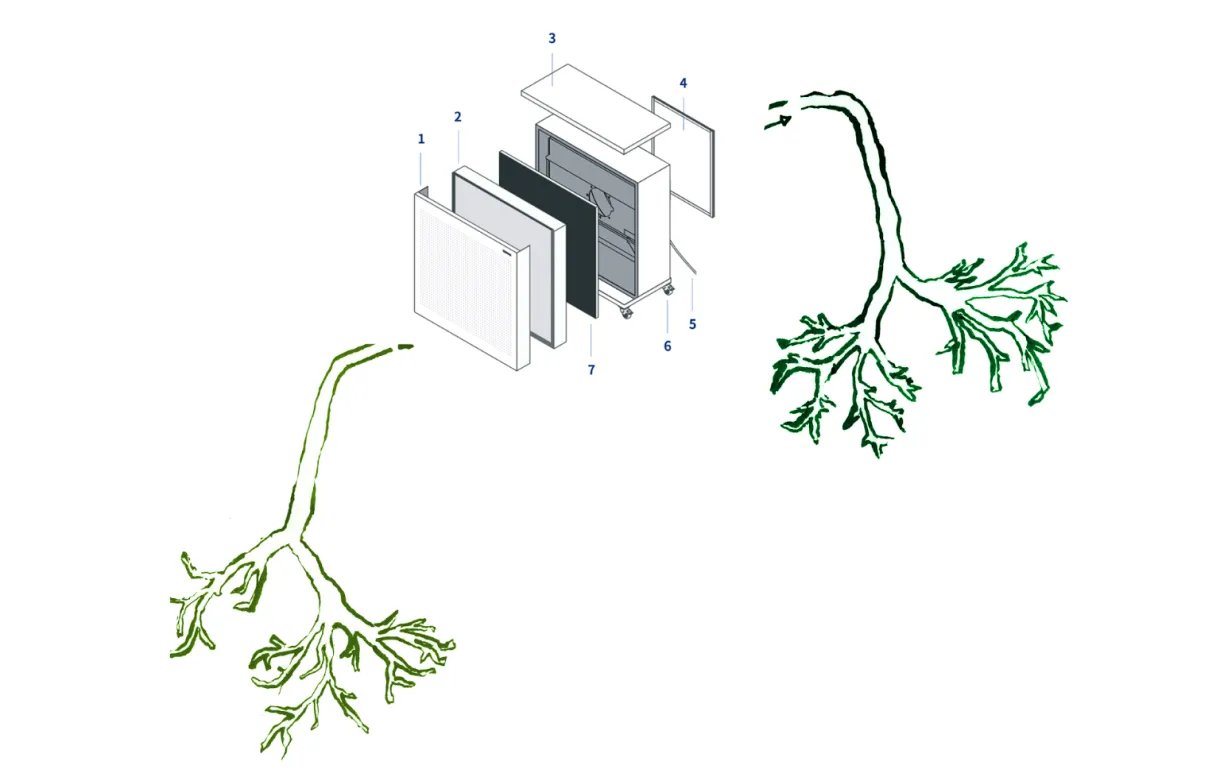
This air purifier’s surfaces are tidy like its cleaning purpose — smooth powder-coated rounded-edge rectangle box – its front a tight geometric grid of small three-pronged holes like petaled flowers, up to my knees, rattling wheels. Might not notice it if other things call louder in your attention, especially in a large room, especially in a room with many sounds and cords and other machines for amplifying sound or casting light and people chatting this way and that before the concert begins. Stationed in its corner, pulling air through its body, this machine works in filtration, and in infiltration.
ode to a purifier in a concert hall, humming endless variations on entanglements in a corner, questions one upon another.
Its mechanism is simple : a fan whirs in its body, pulling air through a HEPA (high efficiency particulate arresting) filter. Briefly: this technology was originally developed to trap radioactive particles of dust floating in the air, and thus keep them out of the lungs of the workers of the Manhattan Project. (how telling, the selective calculations of safety, for only some, by a government creating a weapon of such destruction.) The HEPA filter technology was inspired by a German filter innovation in gas masks, which in turn descended from a lineage of less-effective mask technologies of the mid-19th century, aimed largely to protect workers like miners and firefighters in hazardous environments.
The first residential air purifier was sold in 1963; appliances built to protect us in our homes from harms of our own making – pollutions, poisons – and, in parallel, harms of nature — dust, pollens, airborne viruses — though even these are not fully immune to our influence — pollens from a pattern of city tree planting unlike a forest, viruses left unmitigated by poor public health policy. The same year, the Clean Air Act was signed by Lyndon Johnson, focused on regulating air pollution, its stated intention “to protect the Nation's air resources so as to promote the public health and welfare and the productive capacity of its population.” (Emphasis mine – how telling, the ways a government lumps promises of health to motives of productivity, and implicitly, economy.)
*
This air purifier was made in a factory in China and shipped from there to California and then to New York. It was made out of aluminum, copper, plastic, rubber, latex and paint. (and of the safety of these workers, of the air in the factory, in the mines? more to research, for future writing). This particular air purifier is smooth to my touch, is heavier than I ought to lift, is still bright-white after a year of use. It is owned by no one in particular (purchased by community donations) and lives in a storage unit when not in use, its movement throughout the city coordinated by a rotating collective of twenty-odd chronically ill artists.
In 2024, inspired by other collectives and mutual aid projects around the country, a group of disabled artists and organizers (many with long covid), launched Artists in Resistance (A.I.R) NYC, a lending library of eight high-efficiency air purifiers, volunteers coordinating free loans to community members, organizers, and artists around the city. I brought this air purifier into a concert hall, because this is part of my disabled listening.
I brought this air purifier into my place of work, because it is necessary, for me to be there.
score for infiltration, devised and implemented by AIRNYC
the score, as we follow it : to bring a sounding access machine into the corner of rooms where people are gathering, turn it on .
ongoing iterations have so far included :
duet with free saxophone !
duet with a quintet singing free palestine!
duet with drag performance of i will survive !
duet with the beginning middle and end of a presentation on knowing your rights!
duet with the attending nurse after surgery !
duet with the i dos !
duet with the sweat on the dance floor!
all in B flat.
performance notes : too many rooms still sound like they did in 2019 ! they are missing this soft booming Bb ! infiltrate these rooms, get them in by any means necessary, so more may safely enter. if needed, just say they are musical instruments.
imagine the sound of filter fan as present sound beacon of disabled future, re cast “concert hall with no precautions seeking quiet to hear pins drop” as “in persistent state of recreating 2019,” even as its fliers and websites claim again and again its freshness its newness its cutting edges.
rehearse once a week on zooms if energy allows, to sort logistics, like figuring out, for example, who is available at four on a friday to help with a pickup.
*
To be explicit; we haul these portable purifiers because they are not already in most venues or in most work places. Because some workplaces do not have up-to-date HVAC systems or one that doesn’t have the MERV-13 filters recommended to filter out viruses, to filter out Covid. We haul these portable purifiers because Covid is still present, because the lack of its mitigation is a barrier for immunocompromised and disabled people to safely work, to safely share public spaces, to participate in public life. And because we all deserve safer working and gathering environments.
Who can afford to get sick ? I mean this in layered ways, in the way that for many, still, Covid represents a real risk of prolonged or permanent illness, or death; and also in the ways that we work and gather in a country where many do not have regular access to health care (a system which still does not know what to do for long covid patients), many do not have paid sick leave (as is the case with most musicians), many do not have a financial safety net to carry them through a long illness, and we only have access to a disability benefit system that keeps disabled people in poverty if - and only if - you do qualify (even after 2+ years of lawyer-assisted appeals, many with long covid are unsuccessful).
We could thus think of this purifier as a sculptural bandaid for a set of larger failures or absences. A sort of stop-gap— A piece of furniture, in the absence of a system that could be built into the architecture. A gesture of artists, workers (often the most at risk) to bring a tool to keep them (and their audience) safer in their work place, in the absence of action by an organization or institution, to do so.
*
My sick listening shifts as my body does, the acuteness of the experience like a head ache shouting which, upon subsiding, has made me wonder why I did not consider them a part of my listening before.
sound of a cello — pang of my head — tired ache of how hard it was to get here — sound of cello — will i get sick in this room? — how long will i last in this chair — sound of a violin — look at the ceiling — think about dinner — time without thought in a sound of the cello — clouds of greens and blues in my mind — someone coughs behind me, i am worried— the feeling of my mask — wondering how bisan in gaza is doing — cello — pang — the person next to me is scratching his head — the ceiling is crumbling — a soft feeling of joy comes — my back hurts — so strange to have long covid in an un masked room
I am curious about embracing my multi-pronged experience of my disabled attention, without exerting a desire to control it, without placing value on certain parts of this constellation as more or less valid or less part of the experience of being at a show, in a room, with a group of people — to be in the experience of live music. And, by extension, I am curious about ways to describe a live, communal, music experience in terms of a set of components — of which the composition is only one part.
I had a moment, a few years ago, with a Georgia O’Keefe painting. I made it to MoMA deep in a weeklong migraine, pulled myself there just before a show of her drawings closed. to find the second drawing in the show was one she made of her own headache, while in that state. Parked my wheelchair in front of it for awhile, deeply moved; it felt like a message, somehow – a rare feeling that I, in my sick state, was, for once, in an ideal state to connect with, appreciate, the work.
*
At its back, a single black plastic knob toggles between three speeds of force, once the machine is plugged in, to the outlet, to the network of power in the building in the city. At its back, a square screen that catches the biggest pieces of dust as the air is sucked inside by a large steady fan, and sucked through the tight weave of the filter and pushed back out into the room through its front grid.
At the center of its purpose, the filter holds on to traces, it grabs what is microscopic and what is unwanted or dangerous, viruses, specks of dust, particles from the exhausts of all the other machines we have made — I imagine the purifiers as a sort of communal prosthesis, technology extending our bodies, to do, bionic, what our bodies do not have capacity to filter ourselves.
masks are also a sort of prosthesis — though not a physically shared one, though i imagine some sculptor descendant of Lygia Clark, making one. the reasons to mask do imply a shared responsibility, as they protect ourselves but also protect others, as studies show that everyone masking is safer than leaving masking to only the most vulnerable. but, symbolically, as an object, their loudest signal is of individual access solution, like a pair of glasses.
Imagine — all of us enter a room together and upon our entering we hook up to these machines one by one by our breathing and we become one body together all connected like that, sharing a room, machine holding where our bodies fail, we came together in our blessed weakness and plugged in to the whole city.
A musician sings to the purifiers, at the end of the evening. They were thinking about the ways their relatives sang to the cows they were milking, they were thinking about thanking you. We could sing to you machines for letting us together again. Oh machine you let me sing again in a crowded room. It has always been just a borrowing: we, of this air.
*
Sometimes when you turn them on, they emit the faintest odor of bodies – a trace of the party they attended last week.
When you turn them on, you can feel their presence by the motion of air on your skin, slight and constant breeze where, before, there had been none.
This is a theme to their presence, across senses: a noticing in contrast to absence. Those with typical hearing describe their sound as immediately perceptible—a pink noisy woosh of air and a slight sing of the humming motor at 60Hz and its stack of frequencies. Amongst the chatter of conversation, it is quiet enough that their sounds are most discernible upon turning them off, when the pillow of noise is gone.
on their sound
A curator turned a purifier off during a set because it interfered with the music. Another explained that purifiers couldn’t be present at a show because the music is sensitive (silence is needed).
This weighing is rarely done in the context of problem-solving towards other (quieter) solutions to access (like masking); if it were, this would be a different essay. Instead, they are verdicts, stopping places — where the sensitivity of a (disabled) person is directly held oppositional to the sensitivity of music — with no room for discussion. In these cases, the sonic (aesthetic) need is held more valuable than the bodily (safety) need.
what are we doing here, to be so willing to maintain unsafe spaces in the name of the pursuit of supposedly sensitive sounds ?
*
So, to make room for discussion — first, of course, countless musical traditions, musicians, and music settings do not need or depend on silence, nor hold it as a necessary part of its aesthetic. In those rooms, from dance clubs to noisy rock bars to dinner clubs with clinking glasses and waiters and applause for a good riff — the noise of the purifier of minimal concern, if at all. Instead, in each of these music worlds, disabled people within them grapple to navigate other sets of logics and arguments in order to center or integrate access, and experience other ways that the safety or access of the people in the room are not valued as much as other details (profit, for example).
The expectations – of a quiet hall, and for the audience to behave quietly – have origins in a certain place and time, a remnant of a particular society’s convention: late 19th century European concert halls presenting classical music. This is not to argue that quiet as a desired aural/acoustic condition is wholly new. But, quiet as condition desired above others, quiet a social convention, as enforced set of expected behaviors and norms in a concert hall, this quiet is a recent invention, compared to the long history of listening.
Carnegie Hall, for example, bastion of this particular tradition, provides free cough drops, which they ask you to unwrap before the show so you don’t disturb the music with the crinkling sound, a strange acknowledgement that the audience has bodies that make sounds, entangled with a prescribed and detailed recipe to suppress even the smallest paper utterance.
*
Through the lens of disability, let us read ways these prescriptions for silence imagine our relationship to our body, as communal listeners. Thinking that silence is possible presumes an audience with bodyminds that do not need to move to twitch to stim to grunt to sound to suck drool grunt to clear a throat to tic loudly to get up to the bathroom. Or, it presumes that if we do have bodily needs, we will be able to control them, and do so discretely. It presumes an audience that needs no machines, no diabetes sensors that beep unexpectedly or oxygen devices hissing rhythmically. (Writing, alone in bed, I think – oh how I want to hear a beloved disabled chorus of all these sounds at once! Oh to hear that many disabled people together in one room, all sounding!)
These presumptions create a real barrier for disabled people to be welcomed in these spaces. Audience members often become enforcers of each other, in this social setting; our duty is to supporting the sound with our silence.
But what if we hold these bodily disruptions — whether stim or sound of any access device, including a purifier — as a sort of disabled invitation – to all – to forms of listening outside of this fixation with (or domination of) a tightly-held silence? To ask instead what are the other conditions which might allow a listener to deeply focus on or pay attention to a sonic performance, and for that matter, why hold “focus” as goal? What are the other things happening in the room, with the music? Who are the other people, you are breathing with ?
*
Read generously, the maintenance of silence is a gesture towards creating an environment that enhances the listening experience, that clears away distractions to bring our attention as deeply as possible, to the music.
Indeed, many musicians who hear about the air purifier library, often lead with “but how loud is it?” For indeed – let’s take a moment to glory in our practiced sensitivity to nuances of sound, in what is possible in these extremely quiet rooms, the continuing development of our skills to play with, to work with, this silence – these rooms we have grown up in as musicians, grown used to, our ideal duet companion. And certainly, these purifiers raise the noise floor in a room, contributing around 52 db of white noise when they are turned all the way up. Certainly we don’t have much practice duetting with this, yet, the strange shimmer of white noise at the edge of things. But, what if we practiced – as performers, as venues, as audience members?
I am not arguing against silence, exactly – rather, against a lack of trying, or a lack of conversation around these moments of supposed conflict between needs. For example – perhaps if purifiers became standard equipment at a gig, we might easily picture a set of sonic tinkerers gathering, developing purifiers for different kinds of gigs, humming with different sonic qualities.
Disabled artists ask, to enhance the conditions for attention to the work, why stop at this gesture of making the room quiet? Or, why focus only upon that ? Sonic noise is not the only condition that might draw our attention elsewhere —
This is work that many disabled artists are engaging with, in theater, in sound, in arts — from theaters creating “relaxed performances” to Finnegan Shannon’s bench series for museums. Another element of this, too, from another angle — around access — is the motion against the focus on a single sense in the presentation of work, towards a deeper sense of access across disabilities — sound as the sound itself and the description of the sound and the vibrational experience of the sound and the motion of the musician and of the asl interpreter drawing the phrase. there is a call beyond an aural focus in our experience of listening/music in general — to make space for layered, somatic, and subjective definitions, language, and discussions of attention.
*
Returning to the example of the curator, let’s consider further. Turning a purifier off during a set because it interfered with the music — means that maybe they heard it as on top of the music, as a nuisance as noise.
Enter the listening of a person sick, a person in pain, how they experience a work, a sound — in various forms of bodily “distraction,” shared or divided attention — noise is not necessarily sonic, but could be internal, psychic, bodily. A high risk friend, seeking the words to describe her experience of being covid conscious in a space which no longer required masks, and had no safety mitigations, during a winter surge of covid, finally settles on words to describe it – it is loud, she says.
In this context, a room with mitigation which is sonically louder is simultaneously “quieter” in the experience of a high risk person. A place to lay, horizontally, creating a sort of quiet. Their presence part of a (relatively rare) prioritization of access; a new norm, a different kind of “quiet” to practice with, and to work with ? What sort of improvisations or music come from these new conditions? What relationship to this breezy space, could be cultivated?
the night of the concert at issue project room, this spring, a forest fire blazed somewhere in new jersey — and in new york we breathed it in on our ways to work. a disabled person wrote in ,“due to the poor air quality today, especially for health sensitive groups with respiratory and heart illnesses, my friend and I cannot attend.”
this unknown sick person lying in her bed somewhere, reminds me the changing, ongoing, porous nature of the project of accessibility. with no arrival (the order, tall, to carve out places of access in an inaccessible city, in a warming world)— but a continuous experiment and commitment to attempt, itself a sort of future work trajectory.
later that summer, i arrange to bring the purifiers to her, and do a show in her bedroom, for her and her friend (an experiment to write about, in the next essay).
in so many ways — with this art working, and the organizing of the library — purifiers are, despite their solidness, a sort of floating solution — not the answer, not an end, temporary, porous, open ended, like a question.
i end, by offering a set of questions, which are only a beginning.
- why are disabled people so often expected to offer or have all the solutions to our own inclusion?
- how could these questions of access be held, communally, more equally? what if access were a group project, as it benefits us all ?
- what are the barriers — structural, mental, institutional, values, educational, financial — to doing this, together?
- who else is not in the room?
- how can access as practice show up in understanding of the interconnectedness of all struggles, as a solidarity practice — from free palestine to workers rights?
Anna RG works in composition, sculpture and community organizing, towards possibilities of Sick Music making and listening. For a decade, she toured with her research-based ballad project, Anna & Elizabeth, their Smithsonian Folkways album called a “radical expansion of what folk songs are supposed to do” by The New Yorker. They performed at Carnegie Hall, Big Ears Festival (where she was guest curator of traditional music), NPR’s Tiny Desk and many other venues not currently accessible to high risk artists. Anna has collaborated widely, including with the Aizuri Quartet, Lonnie Holley, Glen Hansard, Paul Wiancko, Jim White, and the dearly departed Susan Alcorn, and has won blue ribbons in fiddle contests across Appalachia. They hold an MFA in sculpture from Bard College, is a MacDowell Fellow, and recently exhibited at Tulca Festival (Galway). She is a member of the collective Artists In Resistance NYC (AIRNYC) which operates a lending library of the community-owned air purifiers used in the show, which are available for anyone to borrow, for free.