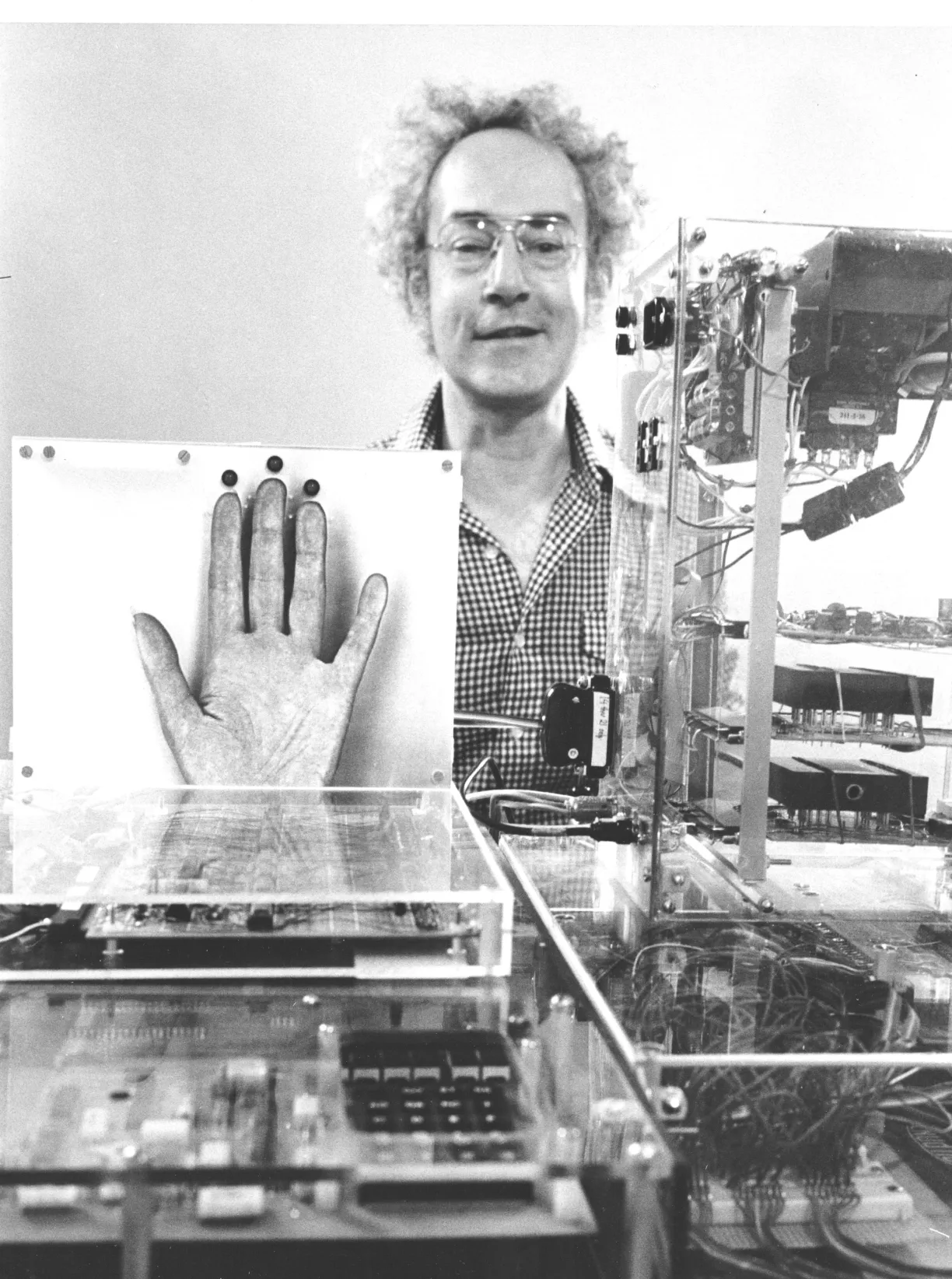
Celebrating David Behrman: In Conversation with Paul DeMarinis, Laurie Spiegel & James Fei
Tuesday, October 7th at 12pm, as part of ISSUE Project Room’s 2025 Gala celebration honoring composer and electronic music pioneer David Behrman, this recorded conversation brings together three visionary artists—David Behrman, Paul DeMarinis & Laurie Spiegel—for a wide-ranging discussion moderated by James Fei. The release precedes ISSUE’s Gala at the 22 Boerum Pl. theater on Wednesday, October 8th, recognizing Behrman’s legacy of collaboration, technological innovation, and influence across generations of experimental music.
Spanning personal histories and the shifting landscape of electronic music, the conversation traces each artist’s early encounters with machines—from soldering irons and analog circuits to early computers and custom software. Spiegel discusses her transition from Buchla synthesizers to programming at Bell Labs; DeMarinis shares his evolution from tape loops and film to self-built computers; and Behrman recalls formative exchanges with figures like Gordon Mumma and Pauline Oliveros, and how hardware limitations often led to unexpected sonic invention. In this rare meeting of minds, the artists explore how electronic music’s ever-changing tools demand perpetual reinvention—and how their early innovations continue to resonate across generations of experimental artists today.
For more information and tickets to ISSUE’s 2025 Gala celebration please contact ISSUE's Director of Advancement & Administration, Monica Pabelonio at monica@issueprojectroom.org, or visit our website. If you can’t attend, please consider making a tax-deductible contribution. A gift of any size helps to support our programs and community of underserved artists.
David Behrman is a composer and artist active since the 1960s. Over the years he has made sound and multimedia installations for gallery spaces as well as musical compositions for performance in concerts. Most of his pieces feature flexible structures and the use of technology in personal ways; compositions rely on interactive real-time relationships with imaginative performers. Together with Robert Ashley, Alvin Lucier and Gordon Mumma, Behrman founded the Sonic Arts Union in 1966. He had a long association with the Merce Cunningham Dance Company as composer and performer, created music for several of the Company’s repertory pieces, and was a member of the Company’s Music Committee during its last years. Pictures, with its music Interspecies Smalltalk, won the Olivier Award in 1985. It remained in the Merce Cunningham Dance Company repertory from 1984 to 1989, and was revived in 2002. Behrman has received grants from the NEA, NYSCA, NYFA, the Japan-United States Friendship Commission, the D.A.A.D., the Foundation for Contemporary Arts and the Henry Cowell Foundation. He was a fellow at the American Academy in Berlin in 2016. Audio recordings of his works are on the XI, Lovely Music, Pogus, New World, WERGO, Black Truffle Records and Alga Marghen labels.
Paul DeMarinis has been working as an electronic media artist since 1971 and has created numerous performance works, sound and computer installations and interactive electronic inventions. He has performed internationally at The Kitchen, Festival d’Automne à Paris, Het Apollohuis in Holland and at Ars Electronica in Linz and created music for Merce Cunningham Dance Co. His interactive audio artworks have been shown at the I.C.C. in Tokyo, Bravin Post Lee Gallery in New York and The Museum of Modern Art in San Francisco. He has been an Artist-in-Residence at The Exploratorium and at Xerox PARC and has received major awards and fellowships in both Visual Arts and Music from The National Endowment for the Arts, N.Y.F.A., N.Y.S.C.A., the John Simon Guggenheim Foundation, the Rockefeller Foundation New Media Award and the D.A.A.D. Berlin Artist Fellowship. Much of his work involves speech processed and synthesized by computers, available on the Lovely Music Ltd. compact disc "Music as a Second Language," and the Apollohuis CD "A Listener’s Companion." Major installation works include: "The Edison Effect" that uses optics and computers to make new sounds by scanning ancient phonograph records with lasers, "Gray Matter" that uses the interaction of body and electricity to make music, and "The Messenger" and "Firebirds" that examine the myths of electrical communication.
James Fei (b. Taipei, Taiwan) moved to the US in 1992 to study electrical engineering but lost his way in music, becoming a composer, saxophonist and electronic musician. Works by Fei have been performed by the BBC Scottish Symphony Orchestra, Orchestra of the S.E.M. Ensemble, Bang on a Can All-Stars, MATA Micro Orchestra and Noord-Hollands Philharmonisch Orkest. Recordings can be found on Leo Records, Improvised Music from Japan, CRI, Krabbesholm and Organized Sound. Compositions for Fei's own ensemble of four alto saxophones focus on physical processes of saliva, fatigue, reeds crippled by cuts and the threshold of audible sound production, while his sound installations and performance on live electronics often focus on electronic and acoustic feedback. Fei received the Grants for Artists Award from the Foundation for Contemporary Arts in 2014 and he is president of Anthony Braxton's Tri-Centric Foundation. Fei has taught at Mills College in Oakland since 2006, where he is Professor of Electronic Arts, Director of the Center for Contemporary Music and heads the Art and Technology Program.
Composer Laurie Spiegel's music draws on her classical training, pre-classical lute, and folk guitar and banjo roots; however, she is also a computer programmer, software designer, visual and video artist, and a published theorist. She is known for her pioneering work with several early electronic and computer music systems, focusing largely on interactive software that uses algorithmic logic to supplement and extend human abilities, and on the aesthetics of musical structure and cognitive process. Spiegel's visual works—computer graphics, video, drawings, and photography—have been exhibited in the United States, Europe, and Japan. She has directed computer and electronic music studios and taught composition at Cooper Union and at New York University, where she founded its first computer music studio. Her realization of Johannes Kepler's Harmony of the Planets was sent into space as the opening cut of the Voyager Spacecraft's record Sounds of Earth (1977). Spiegel's recorded works have been available on 1750 Arch, Capriccio, Philo, Unseen Worlds, and other labels. Her computer software for music, such as Music Mouse—An Intelligent Instrument (1986), has been published for Amiga, Atari, and Macintosh computers. Spiegel has received fellowships and grants from the New York State Council on the Arts, ASCAP, and the Experimental Television Lab at WNET, among others. She is a freelance composer for film, dance, and other media, as well as a writer, software developer, visual artist, and a consultant in computer music, audio software design, and in other areas of information technology. Spiegel's studies include an A.B. from Shimer College and an M.A. from Brooklyn College, and additional studies at Oxford and Juilliard.
Recorded live
Video editing by Meg McDermott.